
Invisalign vs Braces: Which Is Right for You?
Both Invisalign and traditional braces straighten teeth effectively—but they do it differently.

Understanding the pros and cons of each helps you choose the option that fits your lifestyle, budget, and treatment needs.
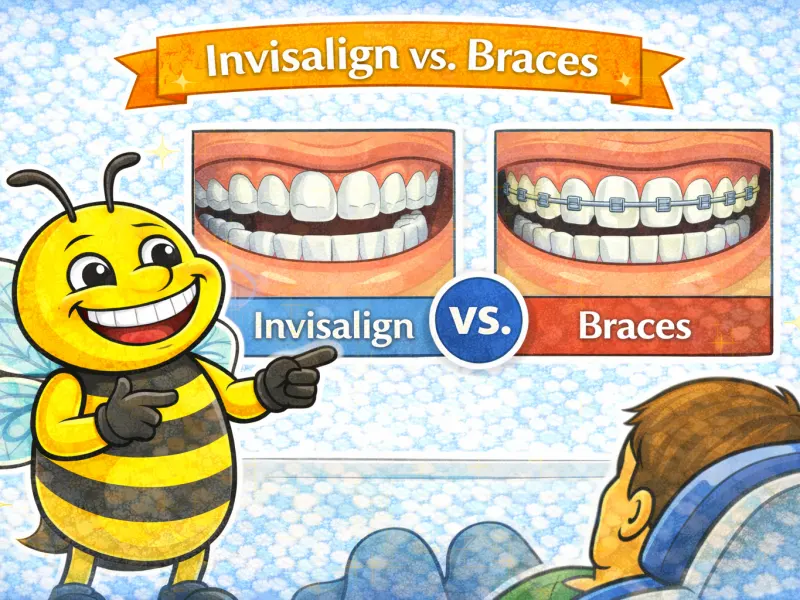
Quick Comparison
| Factor | Invisalign | Traditional Braces |
|---|---|---|
| <strong>Appearance</strong> | Nearly invisible | Visible (metal or ceramic) |
| <strong>Removable</strong> | Yes | No |
| <strong>Food restrictions</strong> | None | Yes (hard, sticky foods) |
| <strong>Treatment time</strong> | 6-18 months | 12-24 months |
| <strong>Office visits</strong> | Every 6-8 weeks | Every 4-6 weeks |
| <strong>Comfort</strong> | Generally more comfortable | Can irritate cheeks/lips |
| <strong>Best for</strong> | Mild-moderate cases | All cases including complex |
| <strong>Cost</strong> | $$$ | $$-$$$ |
Invisalign: Pros and Cons
Advantages
Nearly Invisible — Clear aligners are barely noticeable. Most people won't know you're straightening your teeth.
Removable — Take them out for eating, drinking, brushing, and special occasions. No food restrictions.
More Comfortable — Smooth plastic with no wires or brackets to irritate your mouth.
Easier Oral Hygiene — Remove aligners to brush and floss normally. No special tools needed.
Fewer Office Visits — Check-ins typically every 6-8 weeks vs. monthly for braces.
Predictable Results — 3D technology shows your projected outcome before you start.
Disadvantages
Requires Discipline — Must wear 20-22 hours daily for best results. Compliance is key.
Not for All Cases — Very complex bite issues may require braces.
Aligners Can Be Lost — Removable means they can be misplaced (delays treatment).
Must Remove to Eat/Drink — Some find this inconvenient, especially when snacking.
Cost — Often slightly higher than traditional braces.
Traditional Braces: Pros and Cons
Advantages
Treats All Cases — Even the most complex orthodontic issues can be addressed.
Always Working — No compliance required—braces are attached 24/7.
Can't Lose Them — No risk of misplacing your treatment.
Precise Control — Orthodontist can make very specific adjustments.
Often Lower Cost — May be less expensive than Invisalign.
Fun Options for Kids — Colored bands let kids personalize their look.
Disadvantages
Visible — Metal brackets and wires are noticeable (ceramic less so).
Food Restrictions — No popcorn, hard candy, sticky foods, etc.
Harder to Clean — Brushing and flossing around brackets is challenging.
Discomfort — Wires and brackets can irritate cheeks and lips.
More Frequent Visits — Adjustments needed every 4-6 weeks.
Emergency Visits — Broken brackets or poking wires require repair.
Treatment Effectiveness
What Invisalign Treats Well
- Mild to moderate crowding
- Spacing and gaps
- Overbites
- Underbites
- Crossbites
- Open bites (mild)
When Braces May Be Better
- Severe crowding or spacing
- Complex bite issues
- Significant tooth rotation
- Large overbites or underbites
- Cases requiring precise tooth movement
- Patients who may not wear aligners consistently
The Truth About Effectiveness: For cases Invisalign can treat, results are comparable to braces. The key is proper case selection. We'll honestly tell you which option is best for your specific situation.
Lifestyle Considerations
Choose Invisalign If You:
- Want a discreet option
- Have an active social or professional life
- Can commit to wearing aligners 20-22 hours daily
- Want to eat without restrictions
- Prefer fewer office visits
- Value easy oral hygiene
Choose Braces If You:
- Have complex orthodontic needs
- Prefer "set it and forget it"
- Might forget to wear aligners
- Are younger (teens may lose aligners)
- Want the most affordable option
- Don't mind visible treatment
Cost Comparison
Invisalign
Typically: $4,000 – $8,000
Factors affecting cost: Complexity of case, treatment length, number of aligner sets.
Traditional Braces
Typically: $3,000 – $7,000
Metal braces are usually least expensive; ceramic (tooth-colored) cost more.
Insurance Coverage
Most orthodontic insurance covers both options similarly—often 50% up to a lifetime maximum ($1,500-$3,000 is common).
Treatment Time
Invisalign: Average 6-18 months. Simple cases as few as 3-6 months; complex cases up to 24 months.
Braces: Average 12-24 months. Simple cases 12 months; complex cases 24-36 months.
Treatment time depends on what needs correction, not just which method you choose.
For Teens
Invisalign Teen
Designed for teenage lifestyles:
- Compliance indicators show wear time
- Replacement aligners for lost ones
- Accommodates still-erupting teeth
Teen Braces
Still a great option:
- No compliance worries
- Fun colored bands
- Lower cost often appreciated
We recommend based on your teen's specific needs and personality.
Making Your Decision
Questions to Ask Yourself
- How important is appearance during treatment?
- Can I commit to wearing aligners 20+ hours daily?
- How complex is my case?
- What's my budget?
- How often can I attend appointments?
Our Recommendation Process
During consultation, we evaluate your specific case, discuss your orthodontic options honestly, show projected Invisalign results, and determine if Invisalign is right for you.
Note: At BluSky Dental, we offer Invisalign clear aligners. For cases that require traditional braces, we can refer you to a trusted orthodontist in Ottawa.
Frequently Asked Questions
Sometimes. For comparable cases, treatment times are similar. Some simple cases finish faster with Invisalign; complex cases may be faster with braces.
In some cases, yes. If you currently have braces and want to explore transitioning to Invisalign, we can evaluate your situation during a consultation.
Both cause some discomfort as teeth move. Most patients find Invisalign more comfortable due to no wires or brackets irritating soft tissues.
Find Your Best Option
Not sure which is right for you? We'll evaluate your case and give honest recommendations.
Call: (613) 728-1511
Address: 20 – 1620 Scott Street, Ottawa, ON K1Y 4S7
At BluSky we BEElieve in bringing life to your smile. 🐝