Crowns vs Veneers: Which Is Right for You?
Understanding your restorative options

Both crowns and veneers can transform your smile, but they serve different purposes. Understanding the differences helps you make the right choice for your specific situation.
Quick Comparison
| Factor | Veneer | Crown |
|---|---|---|
| <strong>Coverage</strong> | Front surface only | Entire tooth |
| <strong>Tooth reduction</strong> | Minimal (0.5mm) | Significant (1-2mm all around) |
| <strong>Strength added</strong> | Minimal | Substantial |
| <strong>Best for</strong> | Cosmetic improvement | Damaged/weakened teeth |
| <strong>Lifespan</strong> | 10-15 years | 10-15+ years |
| <strong>Cost</strong> | $$$ | $$$ |
| <strong>Reversibility</strong> | No | No |
What Is a Veneer?
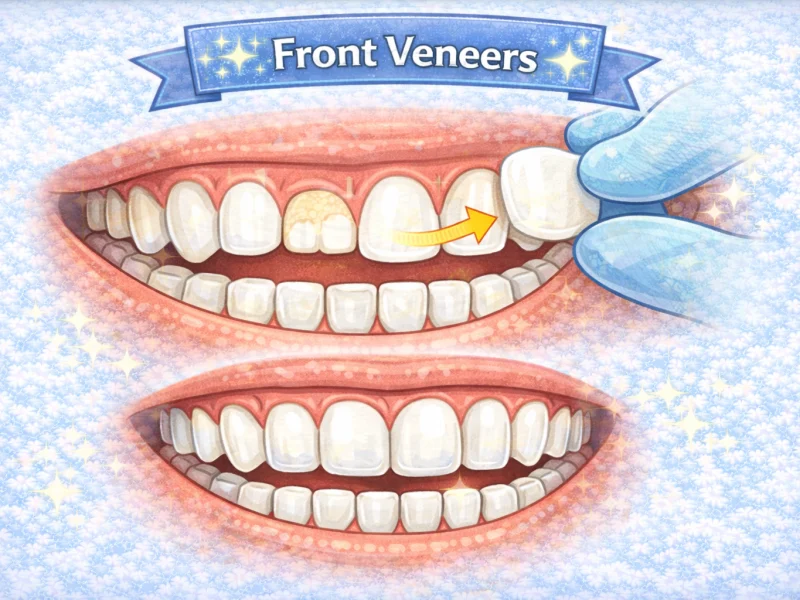
A veneer is a thin shell of porcelain (or composite) bonded to the front surface of a tooth.
Veneers Are Best For:
- Discoloration that whitening can't fix
- Minor chips or wear
- Small gaps between teeth
- Slightly crooked teeth (cosmetic fix, not orthodontic)
- Misshapen teeth
- Smile makeovers on healthy teeth
Veneer Process:
- Minimal enamel removed from front surface
- Impression taken
- Custom veneer fabricated
- Veneer bonded to tooth
What Is a Crown?
A crown is a "cap" that covers the entire visible portion of a tooth, restoring its shape, strength, and appearance.
Crowns Are Best For:
- Large cavities or decay
- Cracked or broken teeth
- After root canal treatment
- Severely worn teeth
- Large fillings that need replacement
- Weak teeth needing protection
- Implant restoration
Crown Process:
- Tooth reduced on all sides
- Impression taken
- Custom crown fabricated (or same-day with CAD/CAM)
- Crown cemented over tooth
Key Differences
Coverage Area
Veneer: Covers only the front (and sometimes edges) of the tooth. The back and biting surface remain natural.
Crown: Encases the entire tooth above the gumline—front, back, sides, and biting surface.
Tooth Preparation
Veneer: Only about 0.5mm of enamel removed from the front surface. More conservative.
Crown: About 1-2mm removed from all surfaces. More significant reduction.
Structural Support
Veneer: Adds minimal strength. The tooth must be fundamentally healthy and strong.
Crown: Significantly strengthens and protects a weakened tooth. Holds cracked teeth together.
Primary Purpose
Veneer: Primarily cosmetic. Improves appearance of healthy teeth.
Crown: Primarily restorative. Repairs and protects damaged teeth (though also improves appearance).
When to Choose a Veneer
Ideal Veneer Candidates:
- Tooth is healthy but cosmetically flawed
- No large fillings
- No cracks or significant damage
- Sufficient enamel for bonding
- Goal is aesthetic improvement
- Tooth doesn't need structural reinforcement
Veneer Advantages:
- More conservative (less tooth removed)
- Beautiful aesthetics
- Stain-resistant
- Can dramatically improve smile
Veneer Limitations:
- Can't fix significantly damaged teeth
- Not for teeth with large fillings
- Not for teeth that need strength
- Can chip under heavy biting forces
When to Choose a Crown
Ideal Crown Candidates:
- Tooth is damaged, decayed, or weakened
- Large existing filling needs replacement
- Tooth has had root canal
- Cracked tooth needs protection
- Severe wear from grinding
- Tooth needs structural support
Crown Advantages:
- Fully protects and strengthens tooth
- Restores function completely
- Highly durable
- Can save teeth that might otherwise need extraction
Crown Limitations:
- More tooth structure removed
- More invasive procedure
- Can't be undone
Can You Have Both?
Yes! Many smile makeovers combine:
- Crowns on damaged back teeth
- Veneers on healthy front teeth
This approach uses the most conservative option for each tooth.
What About Front Teeth?
For front teeth, both options may be possible. Consider:
Choose a veneer if:
- Tooth is healthy
- Problem is purely cosmetic
- You want minimal alteration
Choose a crown if:
- Tooth has large filling
- Tooth is cracked
- Tooth had root canal
- Tooth is severely damaged
Cost Comparison
Both veneers and crowns are similarly priced:
- Veneers: $900-$1,500 per tooth
- Crowns: $1,000-$1,500 per tooth
Insurance often covers crowns (restorative) but not veneers (cosmetic).
Longevity
Both can last 10-15+ years with proper care:
- Avoid biting hard objects
- Wear night guard if you grind
- Maintain excellent oral hygiene
- Keep up with dental checkups
The Decision Process
We'll Consider:
- Current tooth condition – Healthy or compromised?
- Your goals – Cosmetic, functional, or both?
- Long-term prognosis – What gives the best outcome?
- Your preferences – Conservative vs. comprehensive approach
We'll Recommend:
The option that:
- Best addresses your needs
- Preserves the most natural tooth when possible
- Provides lasting results
- Fits your goals and budget
Let's Find Your Solution
Expert Guidance for Your Decision
Not sure which is right for you? Our team will evaluate your teeth and recommend the best approach for your unique situation, goals, and budget.

Frequently Asked Questions
If a veneered tooth later needs more extensive work, it may require a crown. The veneer would be removed and replaced with a crown.
Crowns provide more strength to the tooth because they cover all surfaces. Veneers add minimal structural support.
Both can look completely natural with quality materials and skilled placement. Modern porcelain crowns are as aesthetic as veneers.
You could, but we'd only recommend veneers on healthy teeth. Damaged teeth should receive crowns.
Let's Find Your Solution
Not sure which is right for you? We'll evaluate your teeth and recommend the best approach.
Call: (613) 728-1511
Address: 20 – 1620 Scott Street, Ottawa, ON K1Y 4S7
At BluSky we BEElieve in bringing life to your smile. 🐝